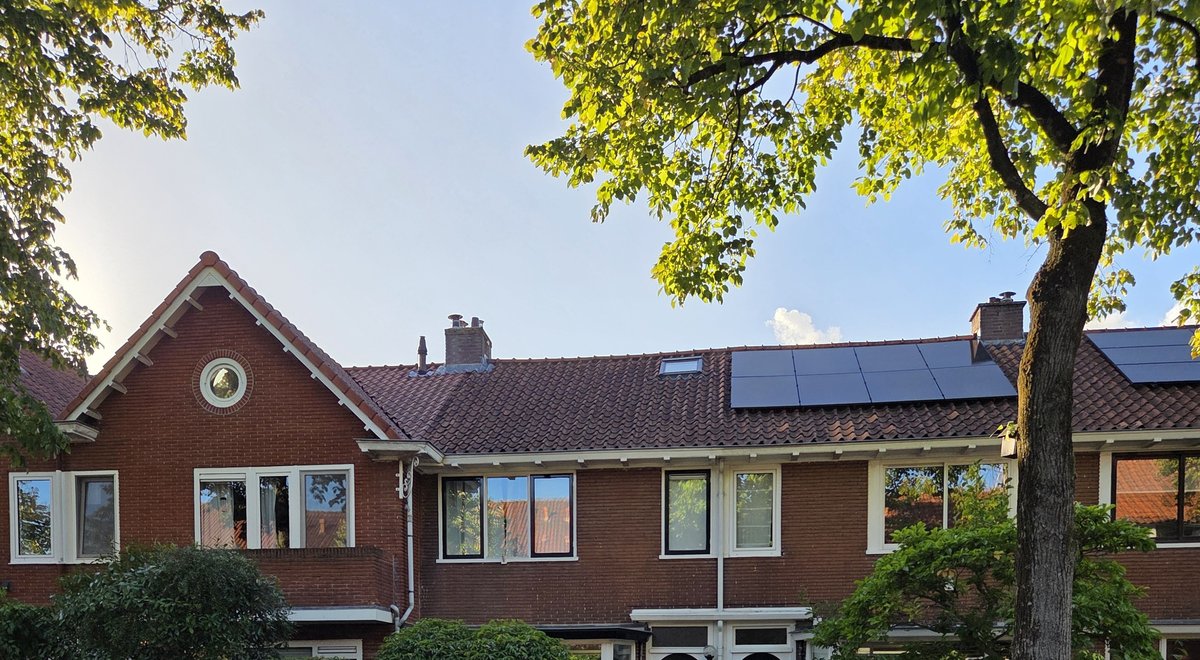


640 homes, one key question: was your cavity ever filled?
Waarder is small: 640 homes according to the BAG register and 1,665 residents according to CBS, together making up one district of the municipality of Bodegraven-Reeuwijk. The median construction year is 1979, but that says little about your house. About 46% was already standing before 1975 and about a third was added from 1992 onwards. The largest group, 37%, dates from 1946 up to and including 1974. Those are the houses where results differ most, because two identical homes on the same street can be two classes apart if one cavity was retrofitted and the other was not.
- Type your postcode and house number into the calculator: the exact price appears at once, with no strings attached.
- Up to 150 m² it costs between €220 and €375. The provincial border adds nothing, because we have no travel or call-out charges.
- Allow 60 to 90 minutes for our visit. A few working days later the registration in EP-online is usually done.
- Already got a buyer or tenant? With our urgent service the label is there within 24 hours of the survey.
See what a label on your Waarder address costs
Do you need to arrange something in Waarder now?
The label obligation does not come from the municipality but is national, so on this side of the border the same rules apply as in Woerden. Whether it concerns you can be read off here:
- Selling: once your house is offered, the class belongs in the text, and everything must be registered before the transfer at the notary. So plan the survey before the home goes online.
- Letting: with a new contract the tenant receives the label. The energy class is among the heavier items in the rent points calculation and so helps steer the maximum rent. As a separate job that calculation costs €175, but it can be done during the same visit, and then you get a discount.
- Surveyed before: a label less than ten years old can simply be reused. The term runs from the survey date, which you can look up in EP-online for your address.
If it is missing at a sale or letting, the Human Environment and Transport Inspectorate may fine a private owner up to €515. Buildings that are only in temporary use do fall outside the obligation.
Fill holes, invoices and the whole window: how we approach the survey
The calculation follows NTA 8800. Inside, we first map which surfaces border outside air, the crawl space or an unheated room. Then we look at how well the roof, walls, floor and glazing insulate, which appliance heats the home, where the hot water comes from and how the home is ventilated.
Not sure whether anything was ever injected into the cavity? Then we track it down on site: we look for fill holes in the brickwork and, where we can, measure the cavity width. Even so, the rule stands that what cannot be seen or proven does not count. An old invoice showing the product type is therefore worth its weight in gold, as it lets us use the actual insulation value rather than an assumption. So take a dive into your files:
- The bill for retrofitting the cavity, ideally with the product name
- Paperwork on floor or roof insulation
- The glass specification plus the frame type: the U-value your glazier quotes covers the pane alone, and the label looks at the complete window
- Make, type and year of your boiler or heat pump
- How many solar panels there are and what their capacity is
Cannot find anything? No disaster, the survey goes ahead and we record what can be observed.
Enter your postcode and see your price
Why a label without a house visit does not exist
The provisional label lapsed on 1 January 2021. Everything that appears in EP-online now stems from a real survey by a company working under BRL 9500, and only such a label holds up at the notary. So when you get quotes, look mainly at what the amount covers. Are travel costs added, is registration included and do you keep speaking to the same person? We set it out side by side:
| Item | Hollands Duurzaam |
|---|---|
| Standard rates | Between €220 and €375 (for homes up to 150 m²) |
| 24-hour express service | Surcharge of 50 to 100% of the label price, depending on the schedule |
| Call-out fee | No call-out fee in Waarder |
| Payment | Afterwards only, no deposit required |
| Turnaround | Standard delivery within a few working days |
| Certification | BRL 9500-MWA-W certified and officially registered in EP-online |
| Proof of quality | Review score of 4.9 from 70 Google reviews |
| Experience | More than 750 registered homes |
What does an energy label cost per property type?
| Property type | From (incl. VAT) |
|---|---|
| Studio / room apartment | € 220 |
| Apartment | € 275 |
| Maisonette / terraced house | € 330 |
| End-terrace or semi-detached house | € 340 |
| Detached house | € 375 |
All prices include VAT, the survey and registration in EP-online. Detached houses over 150 m² and special properties are quoted on request. Want to know what an energy label costs per property type? See the full 2026 price overview.
“Excellent and professional service throughout the energy label assessment process. The inspector was punctual, knowledgeable, and took the time to explain the evaluation in detail.”
“efficient, detailed, friendly, professional - easy recommendation”
“Good and informative contact, energy label arranged within 1 day and for a competitive price.”
“Highly recommended for everyone. Friendly and quick response. Report within a day.”
Hollands Duurzaam is rated on average 4.9 out of 5 based on 70 Google reviews. View all reviews ›
Construction years in Waarder: every period is represented
An overview by district makes no sense here, because all of Waarder is one CBS district in the BAG. The more useful question is when your house was built. No period is missing, although the spread is not even:
- Post-war, 37%: no period is larger. Without retrofitting these houses often end up at D or E. With a filled cavity and double glazing, C comes into view.
- The years around the median, 19%: built from 1975 up to and including 1991, with 1979 as the midpoint of the whole village. C and D are the indication here.
- From 1992, about a third: three nearly equal portions of 13%, 11% and 10%. So Waarder kept adding homes until after 2015.
- From before 1946, 9%: the smallest group, with the lowest indication.
| Building period | Share of the 640 homes (BAG) | Expected label |
|---|---|---|
| Before 1946 | 9% | D - F |
| 1946 up to and including 1974, cavity not filled | 37%, together with the row below | D - E |
| 1946 up to and including 1974, cavity retrofitted | Part of the same 37% | C - D |
| 1975 up to and including 1991 | 19% | C - D |
| From 1992 | About 34%: 13% up to and including 2005, 11% up to and including 2014, 10% from 2015 | A - C |
Figures from the BAG, as of November 2026. Because each period was rounded separately, they add up to 99%. The classes in the right-hand column are indicative: the survey of your home decides the outcome, and later insulation can make a lot of difference.
Waarder Kern, Waarder-Oost and Waarder-West
The one district contains three CBS neighbourhoods with these names. We do not give a separate expectation for each, as the figures above apply to the village as a whole. Better to email us your construction year and what has been done to the house since, so we can think along more precisely.
Part of that 9%, or living in a monument?
Monuments were long on the list of exceptions, but no longer since 29 May 2026: they too need a label at a sale or letting. If the class turns out low, that has no consequences for the building, as making it more sustainable is not mandatory. You can read the background in our article on the energy label for monuments. Do you live in a converted farmhouse, a special property or a detached house over 150 m²? Then the price is on request.
Request your label for Waarder
One class up: cavity, floor or solar panels?
If your post-war cavity is still empty, filling it often gains one to two classes. To a lesser extent the same goes for the floor above the crawl space, and solar panels count directly in the calculation. We discuss the best first step for your case while we are walking round anyway.
- Verbal advice: included in the price of the survey.
- Improvement advice on paper: €85, and you see per measure whether your target class comes within reach.
Also good to know: nationally there is the ISDE subsidy and there are loans from the Nationaal Warmtefonds. When the work is finished, a new label can go on your address.
How to reach us from Waarder
As the crow flies, our office in Woerden is less than six kilometres from the village. From request to registration you keep the same advisor, who comes to measure and registers the label personally. There is no deposit: you pay only after you have received the label.
- Phone: handy when a buyer or tenant is waiting and the label is in a hurry.
- WhatsApp or email: put your address in the message and tell us what you know about the cavity.
Frequently asked questions about an energy label in Waarder
Waarder is just across the provincial border. Do I pay more?
What does a label for my house in Waarder cost?
From which years do the homes in Waarder date?
My house in Waarder is from around 1960. What label can I expect?
Can the advisor tell whether my cavity is insulated?
My home in Waarder is from 1992 or later. Do I still need a label?
How fast can it be if I already have a buyer?
I want to sell my building and it is a monument. What now?
I let a home in Waarder. Do I need a points calculation as well as the label?
Work out the price for your home in Waarder
Service area around Waarder
Right around Waarder we also survey homes in Papekop, Driebruggen, Hekendorp, Oudewater and Woerden. The complete list is on our service area page.
More background on the energy label
Want to know exactly how the label works? In our knowledge base you can read the difference between a provisional and definitive energy label, what Rc- and U-values say about insulation and glazing, what the label classes A to G mean and how to find a registered label in EP-online.