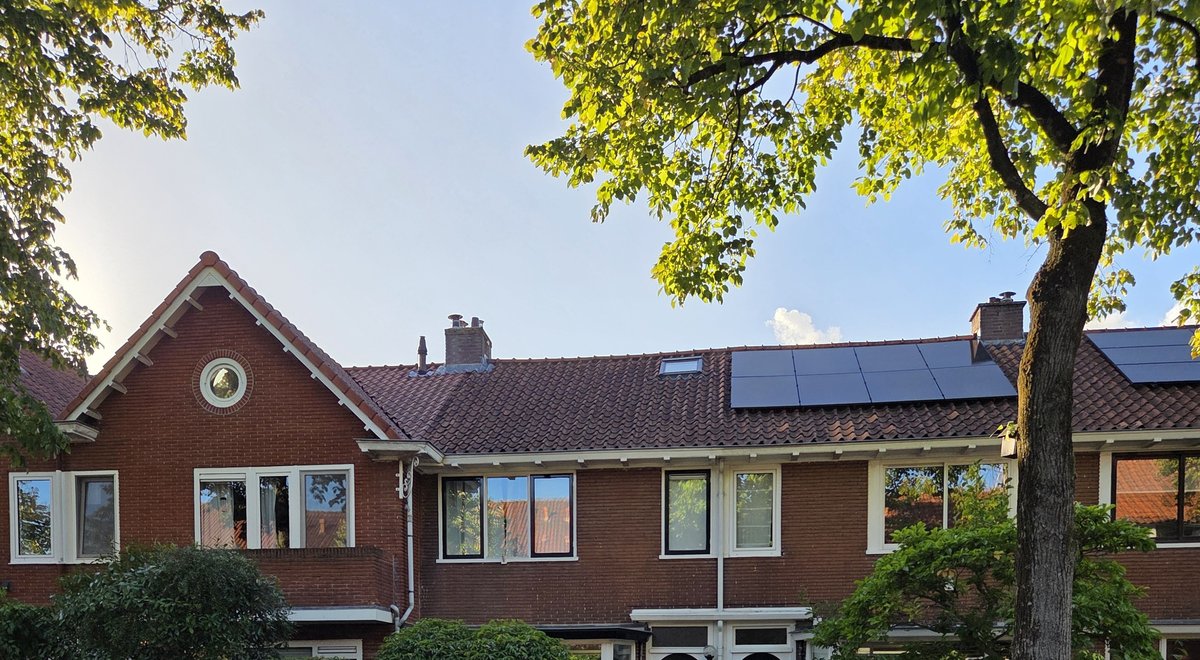


One village, six building periods: in Maasland the year counts
This village has no large neighbourhoods that each belong to one era. All of Maasland falls under a single CBS district in the BAG register, and within it everything is mixed: almost half of the homes were already there before 1975, while over a quarter date from 1992 or later. The median construction year is 1977. Your neighbour may therefore end up in a completely different class from you. That is why our estimate starts with the year of your house and ends with what we find on site.
- Enter your address in the calculator and you know to the euro what you will pay before you agree to anything.
- Expect €220 to €375 up to 150 m², depending on the type of home. Call-out fees do not exist with us, and that includes Maasland.
- We spend 60 to 90 minutes inside your home. After that it normally takes a few working days until everything is in EP-online.
- Is there a deadline? Choose our urgent service and the label is there within 24 hours of the survey.
Find out the price for your Maasland address
Three reasons to arrange a label for Maasland now
Whether you need to act now depends on your plans for the house and on what is already registered. Check where you stand:
- The house is going on the market: an advert without a label class is not on, and the notary completes the transfer with a label already in EP-online. So arrange it at the start of the process, not in the last week.
- You are getting a new tenant: hand over the label at signing. The class feeds into the rent points calculation, and so into the most you may charge. Having that calculation done separately costs €175; together with the label it costs less.
- There may still be an old label: validity ends ten years after the survey. EP-online shows per address what is registered, so look there before you request anything.
If you sell or let without a valid label, the Human Environment and Transport Inspectorate has the power to fine you up to €515 as a private owner. That is a good deal more than the price of a survey.
Old house or young one: what we inspect and what you prepare
The calculation runs on NTA 8800. We go past every surface that can lose heat: to the outside, to the crawl space or to a cold room. We also note the make-up of the roof, walls and floor, the type of glazing, the heating, the hot water, the ventilation and any PV system.
What you can prove, we count. What you cannot prove, the method fills in with fixed assumptions for the construction year, and for a pre-war house those are the lowest there are. Which papers do the most depends on the age of the home:
- Built before 1946: anything showing what has been altered over the years, such as receipts for roof insulation or secondary windows
- Built between 1946 and 1991: proof of a filled cavity and the details of replaced panes
- Built from 1992: the papers the contractor gave you at completion, ideally with building drawings
- Any year: make and type of your boiler or heat pump, and for solar panels the number and capacity
See right away what a label for this address costs
Not a sum from a distance, but someone at your front door
Still got an estimate from before 2021 in a drawer? That provisional label is worth nothing now. Anything that ends up in EP-online only comes about after a visit to the home by a company with BRL 9500 certification. So when comparing, look beyond the bare rate and ask whether the trip and the registration are part of it. This is how things stand with us:
| Item | Hollands Duurzaam |
|---|---|
| Standard rates | Between €220 and €375 (for homes up to 150 m²) |
| 24-hour express service | Surcharge of 50 to 100% of the label price, depending on the schedule |
| Call-out fee | No call-out fee in Maasland |
| Payment | Afterwards only, no deposit required |
| Turnaround | Standard delivery within a few working days |
| Certification | BRL 9500-MWA-W certified and officially registered in EP-online |
| Proof of quality | Review score of 4.9 from 70 Google reviews |
| Experience | More than 750 registered homes |
What does an energy label cost per property type?
| Property type | From (incl. VAT) |
|---|---|
| Studio / room apartment | € 220 |
| Apartment | € 275 |
| Maisonette / terraced house | € 330 |
| End-terrace or semi-detached house | € 340 |
| Detached house | € 375 |
All prices include VAT, the survey and registration in EP-online. Detached houses over 150 m² and special properties are quoted on request. Want to know what an energy label costs per property type? See the full 2026 price overview.
“I contacted Hollands Duurzaam on a Friday evening, and by Monday morning, Mark arrived on time for the inspection. That same evening, the energy label was in my inbox. Mark is a true professional, highly recommended!”
“Pleasant communication, proactive and explains things well during the inspection. Received the report the very next day.”
“Excellent inspection, received quickly. Very friendly and comprehensive help from Mark. In short, highly recommended!”
“I had a very pleasant experience working with Mark from Hollands Duurzaam. Everything was handled quickly and carefully, with excellent service! I highly recommend Hollands Duurzaam.”
Hollands Duurzaam is rated on average 4.9 out of 5 based on 70 Google reviews. View all reviews ›
From 34% post-war to 7% new build: the housing stock of Maasland
In total the BAG lists 2,857 homes in Maasland. The table shows when they went up, because a split by neighbourhood says nothing here. New build is a small group, and the centre of gravity lies well before the turn of the century:
- The post-war years: 34% was built between 1946 and 1974, the largest group in the village. For these houses the question is mainly what has happened to the shell and glazing since.
- 1975 to 1991: another quarter of the stock. The indication is slightly narrower here, but added insulation still has to be provable to count.
- The two extremes: 14% dates from before 1946 and 7% from 2015 or later. Their labels lie furthest apart.
| Built in | Share of the 2,857 homes (BAG) | Expected label |
|---|---|---|
| Before 1946 | 14%, old core and farmhouses | D - G |
| 1946 up to and including 1974 | 34%, the largest group | C - E |
| 1975 up to and including 1991 | 25% | C - D |
| 1992 up to and including 2005 | 13% | A - C |
| 2006 up to and including 2014 | 9% | A - C |
| From 2015 | 7% | A - A++ |
BAG position in November 2026. The percentages are rounded per period, which is why together they come to slightly more than 100. The classes give a direction: only the survey establishes what your house achieves, and a later renovation can take a home well away from this indication.
Dijkpolder, Ter Lucht and Gaag-Maasland: one CBS district
At CBS, the Maasland district covers neighbourhoods including Maasland, Dijkpolder, Ter Lucht and Gaag-Maasland, plus scattered houses in the Dijkpolder and the Duifpolder. We do not publish a label expectation per neighbourhood. To know what applies to you, tell us your construction year, because in this village that says more than your street name.
A building in the core or a farmhouse in the meadows
The core has buildings going back centuries, and in the meadows around it you find farmhouses. With such a farmhouse we first establish where the thermal envelope runs. Solid walls and historic frames with single glazing push the result down, and that is not a mistake in the calculation. The exemption has gone for protected buildings too: since 29 May 2026 a label is mandatory as soon as you sell or let, while nobody forces you to change anything about the building afterwards. Our blog on the energy label for monuments has more on this. For monumental buildings and farmhouses you get a fixed tailored price in advance, as you do for homes over 150 m².
Start your request for Maasland
Scoring higher: what pays off in a house from around 1977?
Because roughly six in ten homes here date from 1946 up to and including 1991, the talk during the survey is mostly about the shell: cavity, roof surface and panes. Solar panels often come on top of that. In a building with solid walls the chances lie elsewhere, in the glazing and the roof. While we walk round, you hear what the first step is in your case.
- Advice at the kitchen table: costs nothing and is simply part of the survey.
- Fully calculated improvement advice: for €85 you know in black and white what it takes to reach the class you want.
Looking for money for the work? See the ISDE subsidy and the loans from the Nationaal Warmtefonds. Afterwards you can have your home surveyed again, so that the improvement also shows on the label.
One advisor from start to finish, and you pay last
Whoever rings your bell in Maasland also handles the registration, so you only have to tell your story once. We do not ask for a deposit. The bill follows after your label has been registered.
- A quick call: the shortest route if the transfer or the new tenant is coming up.
- Via WhatsApp or by email: pass on your address and construction year and we will take a look.
Frequently asked questions about an energy label in Maasland
What amount do I pay for a label in Maasland?
How long do I wait for the label after the survey?
How old are the homes in Maasland, actually?
My Maasland house dates from the 1960s. What class will that be?
Our building in the old core is a listed monument. Is a label mandatory?
I live on a farm outside the village. What is different there?
My home in Maasland dates from after 2015. Do I need to arrange anything?
Can I take over the label of the house next door?
What does the tenant of my Maasland home notice from the label?
Calculate the price for your Maasland home
Service area around Maasland
Live just outside Maasland? We also survey homes in Schipluiden, Den Hoorn, De Lier, Maasdijk and Maassluis. Other locations are on our service area page.
More background on the energy label
Want to know exactly how the label works? In our knowledge base you can read the difference between a provisional and definitive energy label, what Rc- and U-values say about insulation and glazing, what the label classes A to G mean and how to find a registered label in EP-online.