The influence of your central heating boiler on the energy label
Your central heating boiler does more than keep your home warm - it also has a direct effect on your energy label. Together, heating and hot water make up the largest part of a home's energy demand. In this article you'll read how your boiler counts, what the BCRG quality declarations mean, and why the choice of boiler makes a difference to your label.
💡 Want to know what your energy label costs? Enter your address - see the price instantly.
Calculate your price →Why the central heating boiler weighs heavily
The energy label (calculated according to NTA 8800) looks at the total energy demand of your home. The two biggest items in that demand are space heating and domestic hot water - and those happen to be exactly the two jobs your central heating boiler performs. The more efficiently your boiler handles gas and electricity, the better that works out for your label.
An old, non-condensing boiler (VR or CR) performs considerably worse than a modern HR-107 high-efficiency boiler. In the calculation, the difference between an outdated and a modern boiler can quickly add up to part of a label class.
The high-efficiency (HR) boiler as the basis
A high-efficiency boiler (HR-107) recovers heat from the flue gases and therefore uses less gas for the same amount of heat. This is the standard most homes are now equipped with, and the foundation for a well-scoring label when it comes to heating and hot water.
BCRG quality declarations: auxiliary energy and hot water
This is where it gets interesting. For the energy label calculation, an advisor may not simply use the manufacturer's brochure. However, there is an official system of quality and equivalence declarations, managed by the BCRG (the Dutch body for the control and registration of equivalence declarations). This register holds the officially tested performance figures of specific products, which the advisor may enter into the calculation.
Does a boiler have no declaration? Then the advisor calculates with the statutory default (flat-rate) values - and those are deliberately cautious, and therefore unfavourable. With a BCRG quality declaration, the actual, better values may be used. For central heating boilers this mainly concerns two elements:
- Auxiliary energy - the electricity the boiler itself uses (pump, fan, electronics). A lower, verified auxiliary energy works out more favourably in the label.
- Hot water - the boiler's performance when producing hot water (the hot-water efficiency). A better, documented hot-water performance lowers the calculated energy demand for hot water.
The effect: with the right quality declaration, the label often turns out more accurate and more favourable than when default values are used.
Intergas scores best
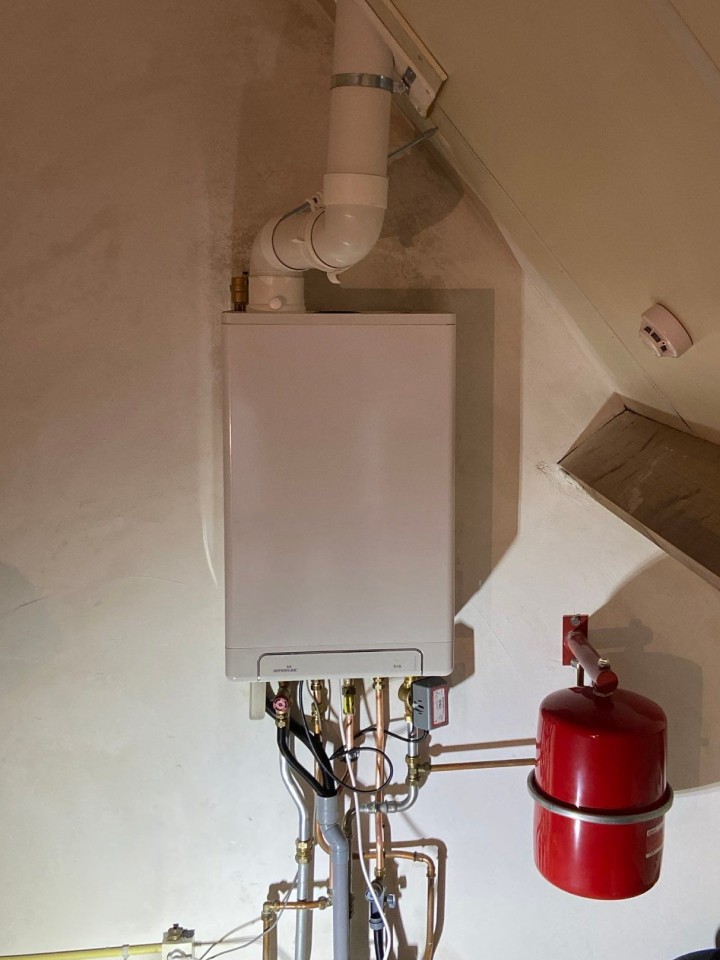
In practice, during our inspections we see that Intergas boilers often work out most favourably in the energy label. For many Intergas boilers, BCRG quality declarations are available with favourable values for both auxiliary energy and hot water. As a result, the label turns out just that bit better than with a boiler without (or with less favourable) declarations.
What does this mean for you?
Want to get the most out of your label? Make sure that during the home inspection we can note the correct brand, type and year of your central heating boiler. Do you have an Intergas boiler - or another boiler for which a BCRG quality declaration exists? Then we apply it in the calculation, so your label is both correct and as favourable as possible.
- Keep the boiler's nameplate or documentation handy
- Not sure about the brand and type? No problem - our advisor checks it during the inspection
- Considering replacement? In our free improvement advice we tell you honestly what a more efficient boiler delivers
Frequently asked questions
Does my central heating boiler affect the energy label?
Yes. Together, heating and hot water make up the largest part of a home's energy demand. An efficient high-efficiency (HR) boiler therefore results in a noticeably better energy label than an old boiler.
What are the BCRG quality declarations for auxiliary energy and hot water?
The BCRG manages the official register of quality and equivalence declarations for the energy label calculation (NTA 8800). With such a declaration, the advisor may use the actual tested values of a specific boiler for auxiliary energy (the boiler's electricity use) and hot water, instead of the less favourable default values.
Which central heating boiler scores best in the energy label?
In practice we see that Intergas boilers often work out most favourably in the energy label, thanks to favourable BCRG quality declarations for auxiliary energy and hot water.
Read also
- Does a heat pump improve your energy label?
- Improve your energy label: from D to A
- Primary fossil energy use: the core value of your energy label
Curious how your boiler works out in the label?
Apply for your energy label with Hollands Duurzaam. We inspect your home accurately - including the central heating boiler - and where possible apply the right BCRG quality declarations. Including free improvement advice.